
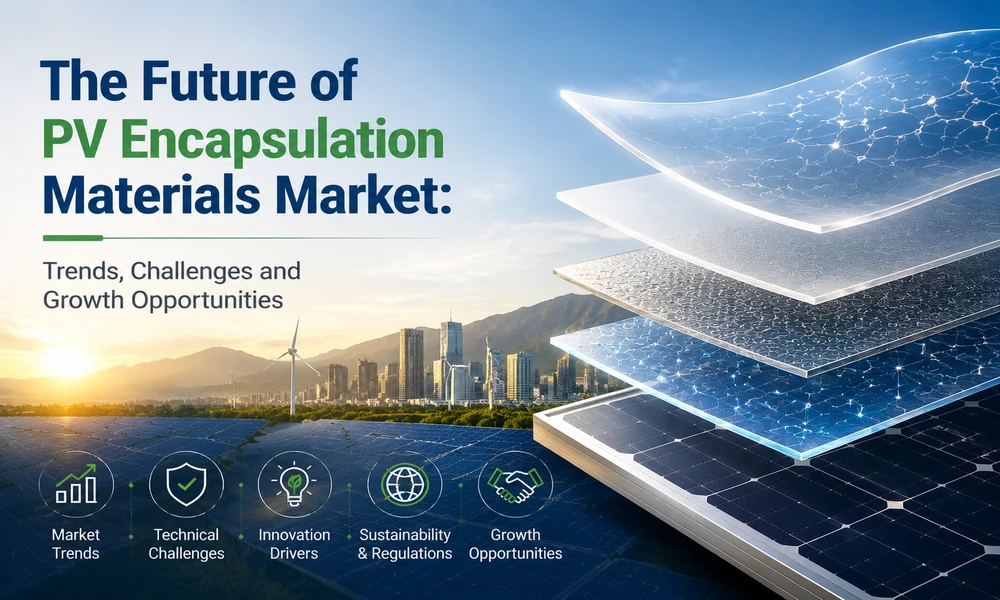
The global photovoltaic (PV) industry is entering a new phase of development. While solar cell efficiency has historically been the primary focus of technological advancement, the industry is increasingly recognizing that encapsulation materials play a decisive role in determining module reliability, lifetime, and real-world energy yield.
PV encapsulation films, including EVA (Ethylene Vinyl Acetate), POE (Polyolefin Elastomer), EPE (EVA-POE-EVA), and emerging advanced polymer solutions, serve as the invisible protection layer between solar cells and harsh outdoor environments. They must provide long-term resistance against ultraviolet radiation, moisture, thermal cycling, potential-induced degradation (PID), and mechanical stress.
As photovoltaic technologies evolve toward TOPCon, HJT, BC, perovskite tandem, and other high-efficiency architectures, the PV encapsulation materials market is experiencing significant transformation. Future growth will be driven not only by increasing solar installations but also by rising requirements for higher reliability, improved performance, and application-specific solutions.
1. Growing Demand for High-Reliability PV Modules Drives Encapsulation Innovation
The rapid expansion of global solar deployment is creating new challenges for module durability. Modern PV projects are increasingly installed in extreme environments, including:
- Desert regions with intense UV exposure and temperature fluctuations
- Offshore and coastal areas with high humidity and salt corrosion
- High-altitude locations with stronger solar radiation
- Utility-scale plants requiring 30+ years of operational reliability
Traditional encapsulation materials have successfully supported decades of PV development, but next-generation modules require enhanced protection.
For example, advanced solar cells with thinner passivation layers and more complex structures can be more sensitive to:
- UV-induced degradation (UVID)
- Moisture penetration
- Chemical interaction with encapsulation materials
- Long-term mechanical stress
This has accelerated demand for specialized encapsulation solutions with:
- Higher UV stability
- Lower water vapor transmission rates (WVTR)
- Better adhesion performance
- Improved PID resistance
- Longer-term optical stability
Encapsulation materials are no longer considered a standardized commodity; they are becoming a key technology component influencing module competitiveness.
2. Technology Transition from EVA to POE and EPE Solutions
For more than 40 years, EVA solar film has remained the dominant encapsulation material due to its excellent balance of:
- Optical transparency
- Adhesion
- Processing compatibility
- Cost efficiency
- Manufacturing maturity
However, the rapid adoption of N-type solar technologies is changing material requirements.
POE: Enhanced Protection for High-Efficiency Modules
POE solar films have gained attention because of their superior moisture resistance and excellent PID performance.
- Extremely low water vapor permeability
- Strong resistance against ionic migration
- Improved durability in humid environments
These advantages make POE particularly suitable for:
- TOPCon modules
- HJT modules
- Bifacial modules
- Modules used in harsh climates
However, higher material costs and more challenging processing requirements limit large-scale adoption in some applications.
EPE: A Balance Between Performance and Cost
EPE solar film combines EVA and POE advantages through a three-layer structure.
The POE core layer provides:
- Moisture resistance
- PID protection
The EVA outer layers provide:
- Strong adhesion
- Better processing compatibility
- Cost optimization
As manufacturers continue to seek performance improvements while controlling production costs, EPE is expected to become one of the fastest-growing encapsulation technologies.
3. New Opportunities from Emerging PV Technologies
The future PV encapsulation materials market will be strongly influenced by emerging solar technologies.
TOPCon Modules
TOPCon has become one of the fastest-growing N-type technologies. However, higher efficiency also increases requirements for long-term reliability.
Encapsulation materials must help prevent:
- UV-related passivation damage
- Cell corrosion
- Power degradation caused by environmental stress
HJT Modules
Heterojunction technology uses temperature-sensitive structures, creating stricter requirements during module manufacturing.
Encapsulation materials must offer:
- Low-temperature lamination compatibility
- Excellent electrical insulation
- Long-term stability
BC and Tandem Perovskite Technologies
Back-contact (BC) cells and perovskite tandem cells represent future directions for PV development.
These technologies introduce new challenges, including:
- More complex interfaces
- Sensitivity to moisture and oxygen
- Higher requirements for optical management
Future encapsulation materials will need to evolve from passive protection layers into functional materials that actively enhance module performance.
4. Sustainability Becomes a Major Market Driver
As solar energy expands globally, sustainability requirements throughout the PV supply chain are becoming increasingly important.
Future encapsulation materials will need to address:
Lower Carbon Footprint
Manufacturers are focusing on:
- Renewable raw materials
- Energy-efficient production processes
- Reduced manufacturing emissions
Improved Recycling Compatibility
With millions of PV modules expected to reach end-of-life in coming decades, recyclable and environmentally friendly encapsulation solutions will become increasingly valuable.
Research directions include:
- Reversible bonding technologies
- Advanced polymer recycling
- Easier module separation methods
Longer Module Lifetime
The most sustainable PV module is one that generates clean energy reliably for a longer period.
By extending module lifetime from 25 years toward 30-40 years, advanced encapsulation materials can significantly improve the lifecycle environmental benefits of solar energy.
5. Challenges Facing the PV Encapsulation Materials Market
Despite strong growth potential, the industry faces several challenges.
Raw Material Price Volatility
Encapsulation films depend on polymer materials such as EVA resin and polyolefin elastomers. Fluctuations in petrochemical markets can affect manufacturing costs.
Increasing Technical Requirements
Future PV modules require materials that simultaneously deliver:
- Higher reliability
- Better optical performance
- Lower cost
- Faster production compatibility
Achieving this balance requires continuous investment in polymer engineering and testing capabilities.
Global Supply Chain Requirements
As solar manufacturing expands worldwide, customers increasingly require suppliers with:
- Regional production capacity
- Stable supply chains
- Local technical support
Encapsulation manufacturers with global manufacturing networks will have stronger advantages in serving international PV markets.
6. Growth Opportunities for PV Encapsulation Material Manufacturers
The future market offers significant opportunities for companies capable of providing customized solutions.
Key growth areas include:
High-Efficiency Module Solutions
Materials optimized for:
- TOPCon
- HJT
- BC
- Tandem solar modules
Extreme Environment Applications
Including:
- Desert PV projects
- Offshore solar farms
- Tropical regions
Integrated Functional Materials
Future encapsulation films may combine multiple functions:
- UV conversion
- Light management
- Thermal regulation
- Enhanced electrical protection
Global Manufacturing and Technical Support
PV module manufacturers increasingly prefer suppliers capable of supporting projects across different regions.
Companies with multiple production bases, advanced R&D capabilities, and international service networks will be better positioned to capture future growth.